



 Dec 30.2025
Harnessing these converging trends equips organizations to build resilient, intelligent analytics capabilities that foster better decisions at speed and scale. The following sections provide a granular roadmap for implementing these innovations with measurable impact across diverse industries including healthcare, finance, marketing, retail, and environmental science.

Using generative AI and agentic analytics to automate data insight generation and accelerate decision-making.
Among the most transformative data analysis trends in 2026, generative AI and agentic analytics stand out by automating the analysis lifecycle from raw data to actionable insights. Leveraging advanced transformer-based models, organizations can now generate detailed narrative reports and detect anomalies without intensive manual effort. This accelerates insight discovery, providing decision-makers with timely and context-rich summaries that were previously unattainable at scale.
Agentic analytics represents a paradigm shift where autonomous systems continuously probe datasets, formulating and testing hypotheses similarly to human analysts but with vastly superior speed and breadth. These systems can, for example, identify emerging market trends for finance firms, detect patient health anomalies in healthcare, or optimize inventory demands in retail without human prompts. Integrating these models into existing BI platforms via APIs and training them on domain-specific data ensures relevance and accuracy.
For instance, a major retail chain that adopted generative AI to produce daily sales summaries and performance analyses reduced manual reporting efforts by 40%, freeing analysts to focus on strategic initiatives such as personalized marketing campaigns and supply chain optimization.
Adopting prebuilt agentic analytics frameworks from leading cloud AI providers can fast-track deployment while mitigating the need for deep AI expertise internally. However, it is critical to maintain rigorous data quality validation to prevent the propagation of bias or misinformation. Properly implemented, this technology elevates analytic agility and empowers organizations to stay ahead in the rapidly evolving BI landscape.
Transitioning from autonomous insight generation, effective decision-making requires melding these AI capabilities with human judgment, a topic explored next in embedding decision intelligence frameworks.
Integrating AI-driven recommendations with human expertise is essential for context-aware, ethical, and effective decision-making. Human-in-the-loop frameworks allow AI to propose options and scenarios while humans apply domain knowledge, values, and ethical considerations, ensuring decisions align with broader business objectives and compliance requirements.
This collaborative approach is particularly crucial in high-stakes areas such as healthcare diagnostics, financial risk assessment, or environmental policy-making. It helps mitigate risks related to algorithmic bias, data errors, or unforeseen consequences by enabling timely human intervention. Organizations that embed such frameworks commonly report higher trust and adoption rates among stakeholders, resulting in decisions that are both data-driven and thoughtfully contextualized.
Moreover, human-in-the-loop processes reinforce accountability, enabling iterative feedback that enhances AI model accuracy and fairness over time. This synergy between machine efficiency and human nuance creates a foundation for sustainable, ethical decision intelligence.

Data engineer configuring scalable multi-cloud and lakehouse analytics architectures for improved performance and governance.
Modern analytics architectures combine the flexibility of data lakes with the structured efficiency of data warehouses in a unified lakehouse approach. This hybrid architecture supports both raw data ingestion and refined analysis, allowing for seamless scaling and faster data access.
Coupling lakehouse architectures with multi-cloud strategies enhances reliability and optimizes costs by distributing workloads across different cloud providers while maintaining interoperability. For example, financial institutions leverage multi-cloud setups to comply with regional data residency laws while still accessing best-in-class analytics services. Similarly, environmental organizations use this flexibility to unify climate data from disparate sources on a scalable platform.
This approach also supports hybrid environments, giving organizations the agility to leverage best-of-breed solutions and avoid vendor lock-in, which is critical for adapting to evolving technological landscapes and regulatory environments.
As AI-driven systems access sensitive data continuously, robust data governance ensures data provenance, compliance, and security. Automated governance frameworks enable real-time monitoring and auditing of data pipelines, helping to detect anomalies, unauthorized access, or compliance breaches earlier.
Observability tools provide transparency into system behavior and data lineage, which are critical for maintaining trust in automated analytics and ensuring that decision intelligence frameworks operate on reliable, compliant data. In sectors such as healthcare and finance, where regulatory constraints are stringent, this observability is essential not only for compliance but for preserving organizational reputation.
Effective governance also fosters data democratization by enabling controlled access, empowering wider teams to leverage analytics while maintaining necessary oversight—accelerating innovation without compromising security.
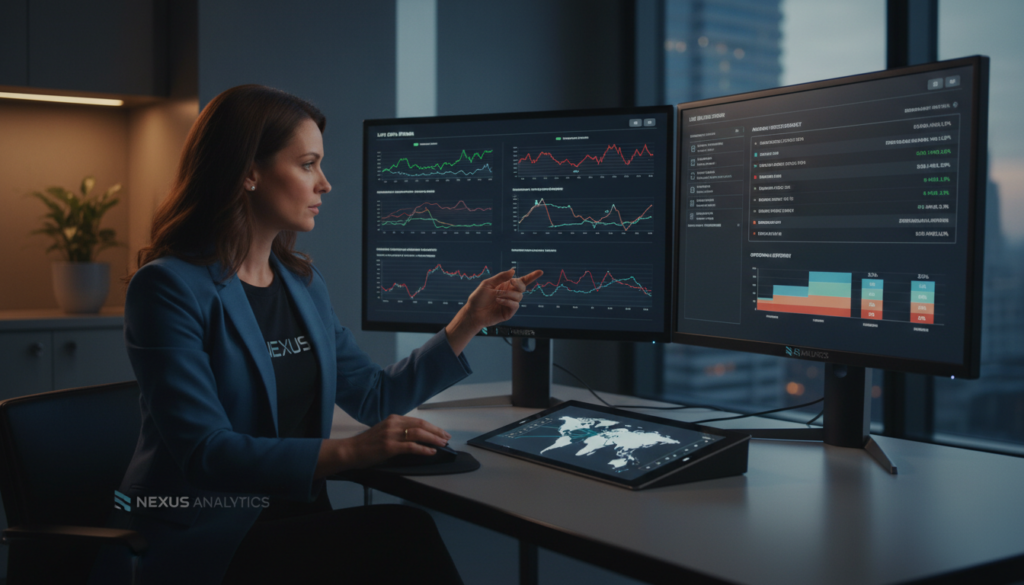
A data analyst monitoring real-time streaming data dashboards to enable agile business responses.
Real-time data processing and streaming analytics empower businesses to respond proactively to changing conditions, such as market fluctuations, customer behavior, or operational issues. This immediacy not only drives competitive advantage but also enhances customer experiences by enabling personalized interactions and rapid incident resolution.
For example, e-commerce companies use streaming analytics to forecast demand spikes and adjust pricing dynamically, while healthcare providers can monitor patient vitals continuously for early intervention.
Operationalizing these capabilities requires tight integration with event-driven architectures and reliable data ingestion pipelines. When successfully implemented, real-time analytics transforms decision-making from reactive to predictive, a critical differentiator in fast-paced industries.
DataOps orchestrates pipeline automation with continuous monitoring and feedback loops, improving the reliability and speed of data delivery. By reducing manual handoffs and error-prone processes, organizations increase analytics efficiency and can iterate quickly on evolving business requirements.
Industries like marketing benefit from DataOps by accelerating campaign data processing, while finance firms streamline regulatory reporting cycles. DataOps tools also provide end-to-end visibility, enabling proactive identification of bottlenecks and facilitating collaborative troubleshooting.
Ultimately, DataOps fosters a culture of continuous improvement and agility, which is vital for sustaining competitive advantage in dynamic markets.
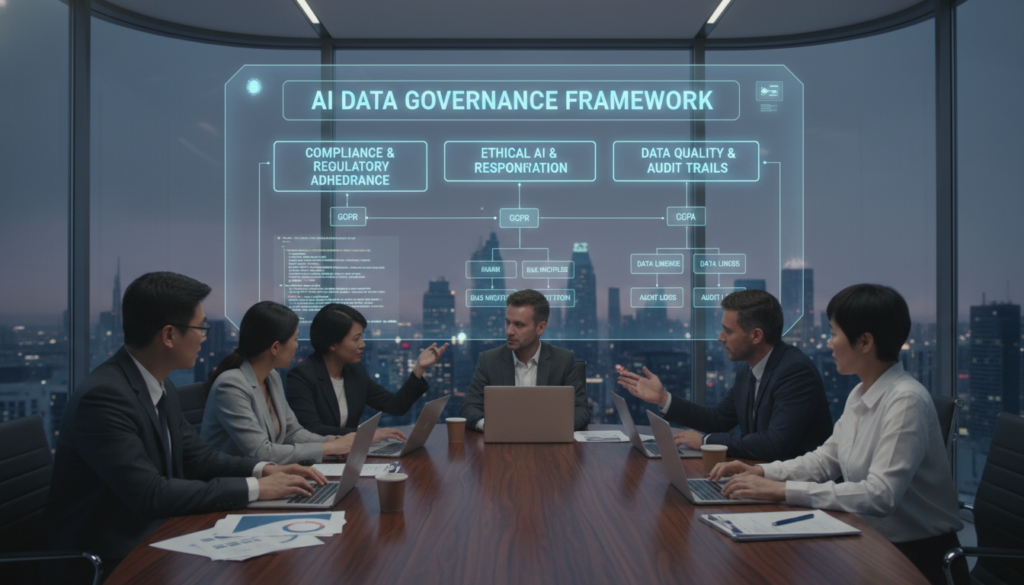
Team collaborating to implement robust data governance and ethical compliance in AI analytics.
While AI automation offers dramatic efficiency and insight gains, it must be carefully balanced with governance policies that safeguard data integrity and regulatory compliance. Organizations should implement controls that enforce ethical standards and maintain oversight over automated decision processes to prevent risks such as data misuse or biased outcomes.
This balance involves regularly auditing AI models, incorporating explainability frameworks, and engaging cross-functional governance committees. In regulated sectors like legal and finance, these controls are critical to meeting compliance requirements and avoiding reputational damage.
By proactively managing these risks, organizations can harness AI’s full potential while upholding trust with customers, regulators, and stakeholders.

Data science professionals collaborating with AI-driven analytics to inform strategic decisions.
To validate AI investments and optimize decision frameworks, organizations must establish quantifiable KPIs and feedback loops that link decision intelligence outputs to measurable business metrics. Continuous monitoring of these indicators helps refine AI models and governance practices, ensuring sustained value generation.
For instance, retail enterprises might track increases in sales conversion attributable to AI-driven personalized recommendations, while healthcare providers measure improvements in patient outcomes linked to AI-assisted diagnostics. Establishing these clear connections between technology and business results drives accountability and guides future innovation investments.
The landscape of data analysis in 2026 is defined by the fusion of advanced AI, automation, and decision intelligence with robust governance frameworks. By strategically leveraging generative AI and agentic analytics, embedding human-in-the-loop decision processes, adopting scalable architectures, and ensuring comprehensive governance and observability, organizations can unlock unprecedented agility and insight.
Operationalizing real-time analytics, automating workflows through DataOps, and maintaining a balanced approach to automation risk empower businesses to thrive amid complexity and rapid change. Crucially, linking decision intelligence investments to tangible business outcomes ensures that data-driven innovation delivers measurable value across industries—from healthcare to finance, marketing to environmental science.
Looking ahead, organizations that embrace adaptable, transparent, and ethically grounded analytics strategies will lead in an increasingly competitive landscape. The challenge is not merely adopting these technological advancements but mastering their integration to anticipate change, drive sustainable growth, and foster trust in an era defined by both data abundance and complexity. The future belongs to those who transform insight into impactful action with speed, precision, and responsibility.

